
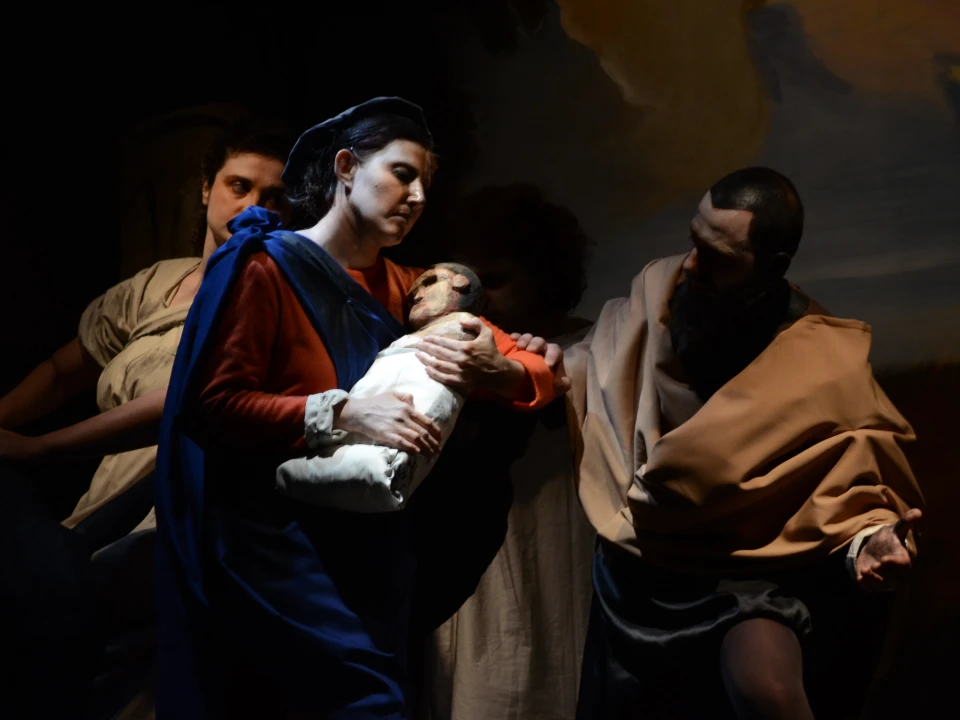
In the town of Avigliano, in the southern Italian region of Basilicata, an unusual artistic tradition transforms people into living paintings. Known as quadri plastici, or “living pictures,” this cultural event combines theater, sculpture, and visual art. Each year during religious celebrations, dozens of residents take part in carefully staged scenes that recreate famous works of art and historical moments.
The tradition dates back more than a century. The first documented performances took place in the late 19th century, when local communities organized religious and cultural events connected to Catholic festivities. Over time, the performances evolved into a distinctive form of artistic representation. Instead of actors moving on stage, participants remain perfectly still, posing to reproduce well-known images from art history.
A typical quadro plastico involves a group of performers arranged on a stage or platform to recreate a specific painting. Costumes, lighting, and props are used to match the original artwork as closely as possible. The participants must maintain their pose for several minutes at a time, sometimes up to 5–10 minutes, while spectators observe the scene. The stillness is essential because the goal is to make the performers appear like figures in a painting rather than actors in motion.
The subjects chosen for these living pictures often come from classical art and religious iconography. Works by artists such as Caravaggio, Raphael, and Michelangelo frequently inspire the scenes. Biblical episodes and historical moments are also common themes. Each composition requires careful preparation to reproduce details such as body position, facial expression, clothing, and background elements.
Producing these scenes requires weeks of planning. Volunteers collaborate with organizers to select the artworks and design the staging. Tailors prepare costumes, carpenters build sets, and lighting technicians arrange illumination to replicate the atmosphere of the original painting. In many cases, the entire community contributes to the preparation process.
Participation is broad and intergenerational. Children, adults, and older residents all take part, sometimes involving more than 100 performers in a single edition of the event. Families often return year after year, and many participants consider their involvement a matter of local pride. For a town with roughly 11,000 residents, the tradition represents an important moment of collective identity.
The event typically takes place during summer celebrations connected to local religious festivals. Temporary stages are installed in public squares, allowing large audiences to gather. Visitors from nearby towns and other parts of Italy travel to Avigliano to watch the performances. For many spectators, the combination of visual precision and human stillness creates a striking artistic effect.
Over time, the quadri plastici have become one of the best-known cultural traditions in Basilicata. The performances blend elements of theater, sculpture, and painting while maintaining a strong connection to the region’s religious heritage. Unlike conventional stage productions, the emphasis is not on movement or dialogue but on visual composition and symbolic meaning.
Today the tradition continues to evolve while preserving its historical roots. Modern lighting systems and stage design have improved the realism of the scenes, but the central concept remains unchanged – people transforming themselves into living artworks. In Avigliano, this unique form of performance demonstrates how a small community can reinterpret the masterpieces of art history through collective participation and creativity.