

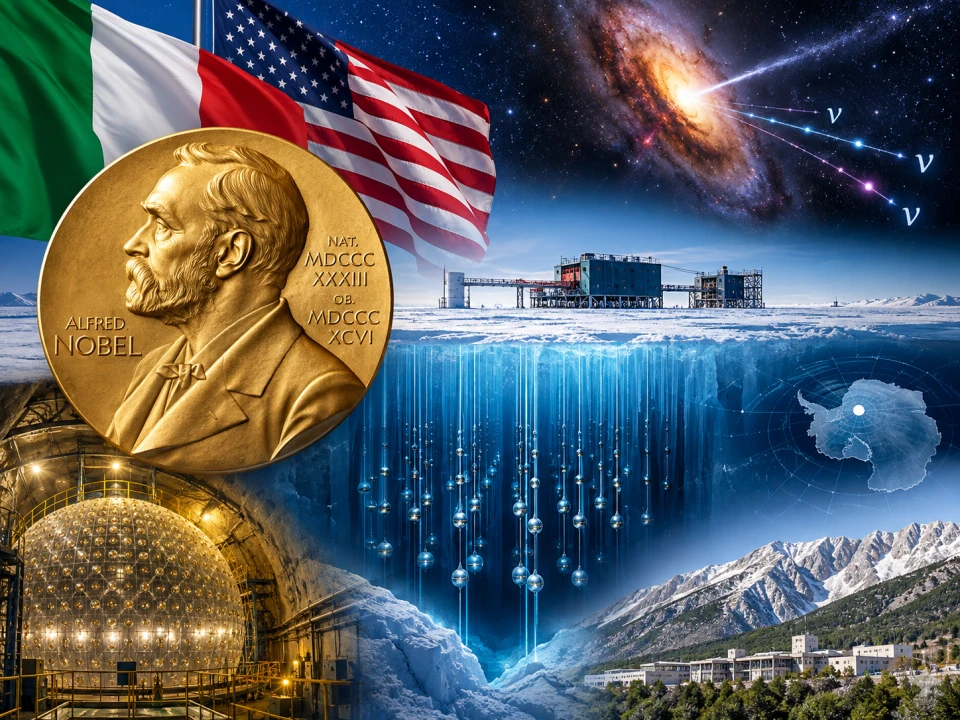
The 2026 Nobel Prize in Physics celebrates a breakthrough in understanding the universe, with Italian scientific excellence playing an important role in the international research behind it.
The award went to Francis Halzen, the 82-year-old Belgian-born physicist at the University of Wisconsin–Madison, for his pioneering contributions to the IceCube Neutrino Observatory and the discovery of high-energy neutrinos originating beyond Earth.
Italy has contributed significantly to this field through its scientists, research institutions, and technological expertise.
The IceCube Observatory, built beneath Antarctica’s ice, uses more than 5,000 optical sensors distributed across approximately one cubic kilometer. Completed in 2010, the facility detected compelling evidence of high-energy cosmic neutrinos in 2013, opening a new era of astronomy.
Italian researchers have helped advance the scientific understanding of these elusive particles. In 2018, Simona Paiano of Italy’s National Institute for Astrophysics contributed to research identifying the distance of TXS 0506+056, a distant galaxy associated with a detected high-energy neutrino.
Italy’s National Institute for Nuclear Physics also supported Halzen’s Nobel candidacy, highlighting the strong scientific relationship between Italy and the United States.
The connection extends to Italy’s Gran Sasso National Laboratory, where the pioneering Borexino experiment, designed by Italian physicist Gianpaolo Bellini, achieved extraordinary results studying solar neutrinos.
Halzen himself was in Italy when his Nobel Prize was announced on October 6, following his participation in BergamoScienza.
The recognition underscores Italy’s outstanding contribution to fundamental physics and its enduring partnership with American scientific institutions.