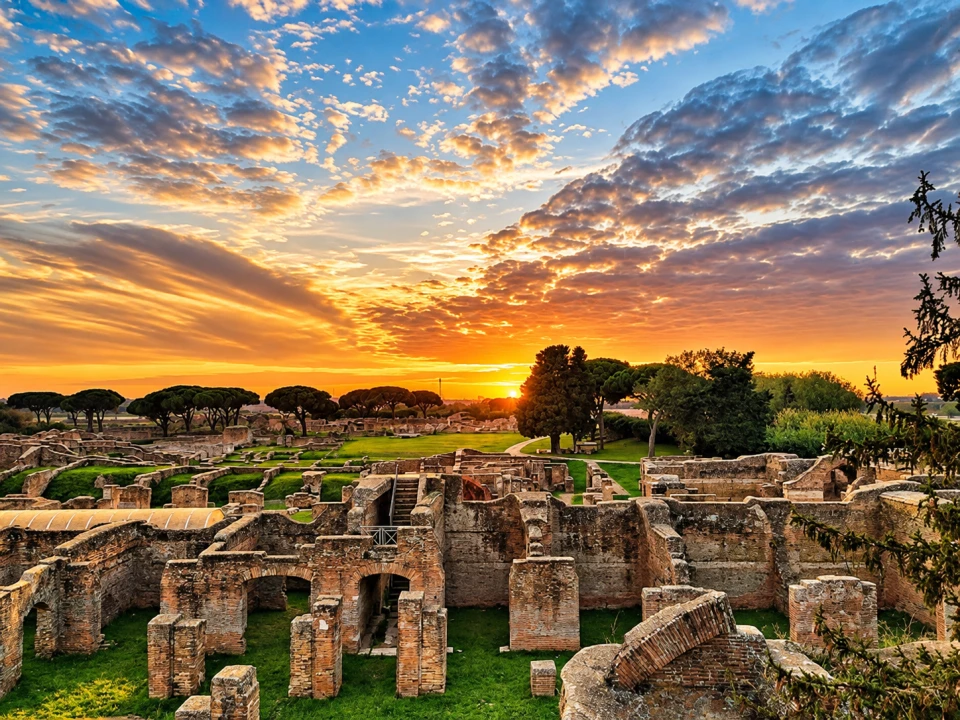
When we think about ancient Rome, the first images that come to mind are usually emperors, monumental temples, military triumphs, and the Colosseum. Yet the extraordinary civilization that shaped much of the Western world was also built by merchants, craftsmen, sailors, shopkeepers, and families whose daily activities rarely appear in traditional historical narratives. Just outside modern Rome, Ostia Antica offers one of the most fascinating opportunities to discover their world.
Located approximately 25 kilometers (16 miles) southwest of central Rome, Ostia developed near the mouth of the Tiber River. According to Roman tradition, it was founded by King Ancus Marcius in the seventh century BC, although the earliest archaeological evidence of a permanent Roman settlement dates mainly to the fourth century BC.
Its geographical position made Ostia essential to the growth of Rome. As the capital expanded, enormous quantities of grain, olive oil, wine, building materials, and other commodities arrived by sea. Ostia became a major commercial center, connecting the Mediterranean economy with the political and administrative heart of the Roman Empire.
Unlike Pompeii, whose destruction in AD 79 preserved a dramatic snapshot of life, Ostia developed and changed over many centuries. Its archaeological remains reveal how an urban community adapted to commerce, population growth, and the changing needs of Roman society.
Walking along the Decumanus Maximus, the principal east-west street, visitors encounter a city that feels surprisingly familiar. Apartment buildings, shops, warehouses, public baths, restaurants, and communal spaces demonstrate how Romans organized everyday urban life.
One particularly revealing feature is the insula, a multistory residential building that accommodated people who could not afford the spacious private houses associated with wealthy Roman families. Some buildings in Ostia originally rose several stories high, with shops occupying the ground floor and apartments above.
These structures remind us that apartment living, mixed-use buildings, and densely populated neighborhoods were already important characteristics of urban life nearly 2,000 years ago.
Food was another essential part of Ostia's social identity. The city's thermopolia, establishments where prepared food and drinks could be purchased, illustrate a culture in which eating outside the home was common. One famous example preserves a masonry counter, storage installations, and painted decorations associated with food and commerce.
Public baths provided more than opportunities for personal hygiene. They were places for conversation, exercise, relaxation, and social interaction. The Baths of Neptune, with their remarkable black-and-white mosaics depicting marine creatures and mythological figures, demonstrate the artistic sophistication of spaces used by the broader urban population.
Commerce shaped the city's international character. At the Piazzale delle Corporazioni, behind the theater, mosaic inscriptions and symbols identify commercial operators associated with different Mediterranean ports and regions.
The representations of ships, dolphins, and other maritime imagery evoke the extensive networks that connected Roman Italy with North Africa, Spain, and other territories.
Ostia was also a religiously diverse city. Archaeologists have identified temples dedicated to traditional Roman gods, sanctuaries associated with eastern cults, a synagogue, and evidence of early Christian communities. The city's inhabitants brought different languages, customs, and beliefs into daily contact.
This cultural complexity challenges the idea of ancient Rome as a socially uniform civilization. Its prosperity depended on movement, exchange, and the coexistence of people from many backgrounds.
For modern Italians, Ostia Antica represents an especially valuable part of the national archaeological heritage. Its streets and buildings preserve the experiences of people whose names have largely disappeared but whose contributions helped sustain one of history's most influential civilizations.
The archaeological park also demonstrates the importance of Italy's continuing work in conservation, research, and cultural education. Excavations and restoration projects allow new generations to understand ancient society beyond the achievements of emperors and military leaders.
Ostia Antica ultimately reveals something fundamental about Roman civilization: its greatness was not confined to monuments and political power. It also emerged from the ordinary routines of working, trading, eating, worshipping, and living together.
In those everyday experiences, separated from us by almost two millennia, we discover a remarkably recognizable human world.