
The President of the Dante Alighieri Society of Michigan Lia Adelfi welcomed newly-arrived Consul of Italy in Detroit Paolo Zanotto to the event commemorating Giorno della Memoria, International Holocaust Remembrance Day, on February 1, 2026. She presented him with an honorary membership to the Dante Alighieri Society of Michigan.
Consul Zanotto began the afternoon’s program by giving an interesting overview of his native city of Padua, in the Veneto region of Italy. Padua is home to one of the oldest universities in the world, founded in 1222. Nicholas Copernicus studied there and Galileo Galilei taught there. The University of Padua began teaching medicine in 1250 and is home to the oldest anatomical theatre. It was the first university in Italy and in Europe to admit Jewish students, particularly for medical studies. The first recorded student graduated in 1409. In 1678, Elena Lucrezia Piscopia was the first woman in Italy, and the world, to receive a university degree. She was awarded a PhD in philosophy from the University of Padua on June 25, 1678.
The Pontifical Basilica of Saint Anthony, dedicated to Saint Anthony of Padua, is the most important monument in the city and one of the world’s most important art treasures. The Scrovegni Chapel, a UNESCO World Heritage site, contains a fresco cycle by Giotto. He revolutionized 14th century art by representing natural human beings showing dramatic facial expressions and body language to convey emotions such as grief, pain, and tenderness. His focus on human emotion served as a bridge from the Middle Ages to the Renaissance. Dante Alighieri spent time in Padua during his exile from Florence, and maintained close ties with Giotto while he was painting the Scrovegni Chapel.
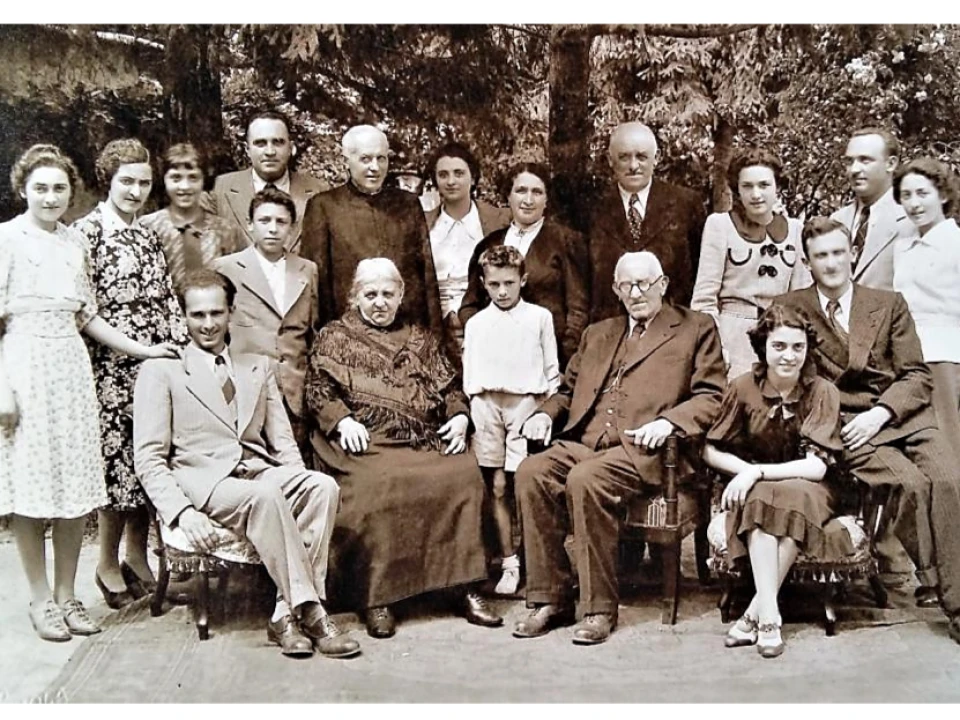
Next Consul Zanotto shared for the first time in public “A Family’s History of Resistance in Nazi-Occupied Padua”, the amazing story of the Martini family. Consul Zanotto’s grandmother Lidia was one of the twelve children in the Martini family. On Armistice Day September 8, 1943, five of the six Martini brothers were in the military. Four of them and their brother-in-law were prisoners of war and one brother was missing. After the Armistice, citizens began hiding allied prisoners, including matriarch Teresa Martini. The occupying Nazis offered 5 kilograms of salt, which was impossible to obtain, and 5,000 lire to anyone who would reveal who was hiding prisoners.
The turning point came when Lidia met Armando Romani, Romani was the Milanese frontman of the clandestine network 'Fra-Ma' (Ezio Franceschini of the Catholic University and Concetto Marchesi future Rector of the University of Padua). The Martini sisters, Teresa, Lidia, Liliana and Renata, began collaborating with Father Placido Cortese, who had become the Paduan frontman of ‘Fra-Ma’. Lidia recounted “We would go to his confessional which served as a meeting place and say: ‘There are 14 brooms’, that is 14 prisoners, then he would give us the funds and go to the offices to make the documents.'”
After the first bombing of the city, the catena di salvezza, rescue chain, was created in Padua: from December 21, 1943, to March 14, 1944, the Martini sisters, along with Milena Zambon, Parisina Lazzari, Delfina Borgato, and her aunt Maria, brought approximately 300 former Allied prisoners and some Jewish acquaintances to safety by train at the Swiss border. The route was Padua-Milan, then Milan-Oggiono on Lake Como, where the prisoners were entrusted to the messengers hired by Armando Romani and taken to safety in Switzerland.
On March 14, 1944, Teresa and Liliana were arrested by the SS, who had infiltrated the Allied prisoners slated for subsequent transport to Switzerland. Taken to their house on Via Galilei, "we were subjected, separately, to relentless interrogations...both Teresa and I denied, denied, and continued to deny." Liliana threw the civilian clothes intended for the prisoners out of the bathroom window, but the SS seized a bundle of thousand-lire notes from Teresa's bedside table. They were taken with other companions, including Maria and Delfina Borgato, to the Santa Maria Maggiore prison in Venice: separate punishment cells, with "special treatment" of interrogations and beatings, and only one liter of water a day for drinking, washing, and cleaning their clothes. They had been sentenced to death, a sentence later commuted to internment. On July 26, they were transferred to the Durchgangslager in Bolzano (Gries).
Of the other two sisters involved in the "rescue chain," Renata was saved because she was away from home at the time of her sisters' arrest, and later hid in a room behind the altar of the Canossian church in Schio. Lidia was saved because she was in Milan after having brought two Jewish acquaintances to Oggiono to cross the border. Upon learning of the arrest by chance over the phone, she took refuge in Annone Brianza. After a few months, thinking the situation had calmed down, Lidia returned to Padua but was arrested on January 17, 1945, taken to Venice, then to solitary confinement in Verona, and finally to Bolzano (Gries), where she worked as a washerwoman until the liberation on May 3, 1945. The Bolzano (Gries) transit camp, established in the summer of 1944, was also a place of torture and death; approximately 300 prisoners were killed in ten months.
From Bolzano, Teresa and Liliana were taken by cattle car to Mauthausen. Teresa said: "Liliana, we will never leave this place alive." At Mauthausen, extermination was carried out through backbreaking labor and exhaustion; approximately 130,000 people were killed in three crematoria. One morning, Liliana and Teresa were ushered naked into a large white-tiled room and waited to finally take a shower; they were actually in the gas chamber. Instead, they were let out and only realized that they were 'miraculously alive' when they were taken first to Linz and then to Grein an der Donau to be employed in German war factories. In Linz the environment is cosmopolitan, the sisters work in a war factory, Teresa sitting at the milling machine, Liliana standing at the lathe in 12-hour shifts alternating day and night.
In the Grein labor camp, Teresa and Liliana have to assemble small parts for the Stuka engines. Liliana suffers from malnutrition and bone decalcification. The only positive aspect is that they can write home because, says Liliana, 'we are free citizens and can receive any mail.' On May 6 or 7, they escaped from the Grein camp to Mauthausen, which was liberated by the Americans on May 5, arriving in Padua on the afternoon of June 5, 1945. They learned that Padre Placido Cortese had been captured by the SS and tortured to death.
They were finally reunited with their family and their brothers returned from captivity, except for Alessandro, who was presumed dead after his plane had crashed in Tunisia. All four of the sisters were married and became teachers. The Martini sisters and their brother Mario received recognition from the Allies for what they had done. Teresa, Lidia and Liliana were also granted war pensions and also received the "Hitler's Slaves" compensation from Germany.
The sisters did not reveal what they had done until fifty years later. When asked why, Lidia said "None of us did it because we wanted to forget; it wasn't something to remember. What we did felt right, so we did it, and that's it." Liliana said "After nearly 50 years of silence, incredibly shared with my parents and siblings, I now feel compelled to bear witness to the part of Nazi madness I endured, so that the memory of the atrocities and heroism it spawned is not lost, in defense of the values for which many paid with their lives."
Finally the Martini sisters received their just recognition. On April 25, 2015, President of the Republic Sergio Mattarella, speaking at the ceremony celebrating the 70th Anniversary of the Liberation, said that alongside the heroes who “gave their lives for our freedom… we must place alongside the everyday heroes who saved lives, who gave shelter to Jews, who provided care and support, like the sisters Lidia, Liliana, and Teresa Martini, from Padua, who led the escape from the concentration camps of dozens and dozens of Allied prisoners, first by giving them bread and a hiding place, then by directing them at night to Switzerland, through the network built by Father Placido Cortese and two renowned Latin scholars, Ezio Franceschini, of the Catholic University, and Concetto Marchesi, later rector of the University of Padua and a Communist deputy…” On November 28, 2025, the footbridge over the Brentelle River in Padua was named after the Martini sisters.
Consul Zanotto is rightfully very proud of the role his grandmother and great aunts played in the Resistance movement. We are honored that he chose to share this story with our community for the first time.