
There are exhibitions you visit. And then there are exhibitions that, in the end, force you to ask questions. Raphael: Sublime Poetry, at the Metropolitan Museum in New York (March 29 to June 28, 2026), is one of these. Because its greatness lies not only in the numbers – over two hundred works, seven years of work, around 10 million dollars invested – but in its ability to construct a vision. A vision that, inevitably, concerns us.
Entering the galleries, you immediately perceive something that normally does not exist. Not a simple sequence of masterpieces, but an unrepeatable constellation. Works that rarely travel, that belong to different institutional histories, which here, for the first time, are placed in relation to one another. And then something powerful happens: Raphael stops being a sum of isolated masterpieces and becomes a system.
There are works that, on their own, would be enough to justify a journey.
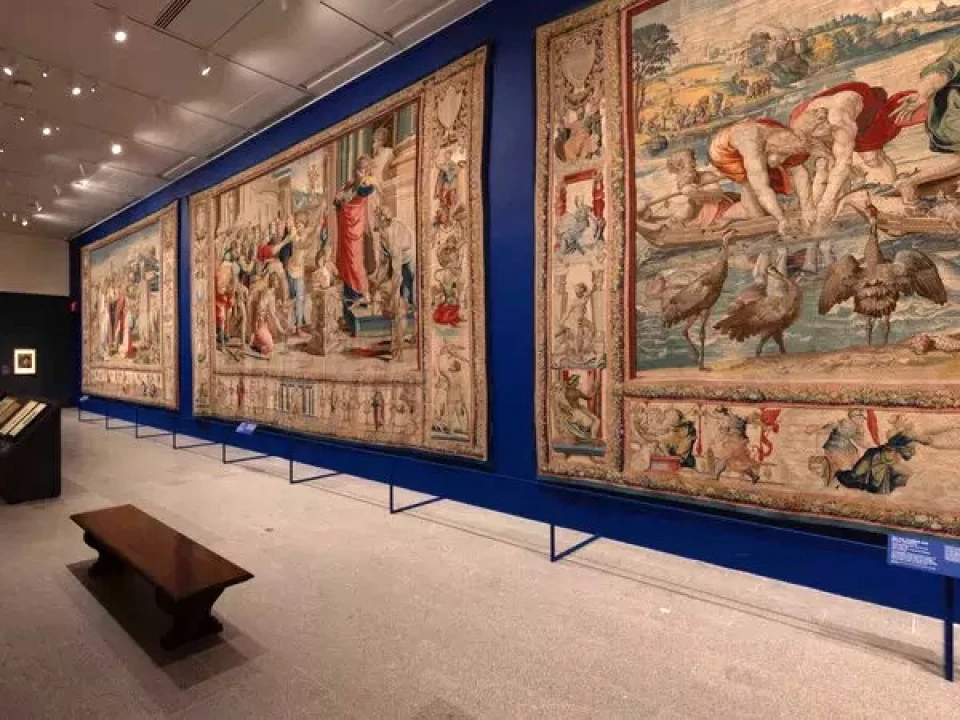
La Fornarina, from Palazzo Barberini in Rome, an absolute icon, enigmatic, intimate. La Muta from Urbino, with that psychological suspension that still today disorients and captures the gaze. The Portrait of Baldassarre Castiglione from the Louvre, perhaps the most modern portrait of the Renaissance, built on a human depth that anticipates centuries. Then the Lady with the Unicorn from the Galleria Borghese, the Ecstasy of Saint Cecilia from Bologna. And then the tapestries of the Sistine Chapel, derived from Raphael’s cartoons: monumental works, created to dialogue with Michelangelo, which here enter a completely different context, revealing all their narrative and political power.
Within this perfect machine, the Italian works play a central role and engage in dialogue with paintings from the Louvre, the Prado, the National Gallery, just to name a few. These works are not simply displayed. They are placed in relation. And this is the point: we Italians have never seen them like this either.
It is not only a matter of loans, but of constructing meaning. Seeing La Fornarina and Baldassarre Castiglione together means understanding two different ways of constructing identity. Juxtaposing portraits with tapestries means moving from intimacy to the representation of power. It is a kind of montage, almost cinematic. Necessary for an American audience, but effective also for those coming from a Eurocentric culture.
There is, however, another element that makes this exhibition exemplary: the awareness of its limits. The great altarpieces such as the Baglioni Altarpiece, the Deposition, are not here. They cannot be. They are panel paintings, fragile, immovable. And so the exhibition chooses another path: telling their story through drawings.
Over 170 sheets allow visitors to enter Raphael’s creative process, to reconstruct what cannot be moved, to see the work before the work. It is an intelligent, contemporary choice. Not to force the masterpiece, but to expand knowledge. Raphael thus emerges not as an icon, but as a system, as an artist capable of building networks, managing relationships, engaging with power – a contemporary artist. Not only for his painting, but for his way of being in the world.
And this is where the curatorial strength of this exhibition becomes clear. Within this construction, Italy is everywhere. Thirty-seven loans come from our country. It is our heritage that makes this exhibition possible. But we are not the ones telling its story. And this is the fracture. Because while we preserve, others construct the global narrative. And they do so with tools that, quite simply, work better.
The exhibition’s main sponsor is Morgan Stanley. And this is not a detail. It is the key.
In the United States, the relationship between public and private in culture is structural. Patronage is not seen as a contamination, but as a resource. Funding an exhibition of this level means participating in a project of global prestige, building reputation, making a long-term impact.
It is a system. The Met is able to mobilize private capital, integrate it with public resources, and transform it into a cultural project on a global scale. It has long timelines, autonomy, decision-making capacity. Raphael’s youthful processional banner, restored by the Central Institute for Restoration thanks to funds from the Met, is concrete proof of how the relationship between public and private can produce knowledge and preservation. In the United States this awareness is structural, while in Italy – also thanks to the Art Bonus – patronage is growing, but still struggles to become a true systemic driver of cultural policy because we continue to have an ambiguous relationship with private support. We invoke it, but we fear it. We regulate it, but often suffocate it. We have legislative tools and regulations that are not always up to date. Slow procedures, rigid constraints, cultural distrust. The result is that the heritage remains, but the ability to build major international operations weakens.
And so this happens: the works leave Italy and the narrative is constructed elsewhere. If we have the most important heritage in the world, why do we not have the same level of ability in telling its story? Why does the Renaissance, which was born in Italy as an integrated model of art, politics, and economy, today find its most effective representation elsewhere? Perhaps the answer lies right here, in these galleries: in the ability to bring together public and private resources, vision and courage, preservation and planning. Raphael, after all, had already understood this five hundred years ago. And us?