
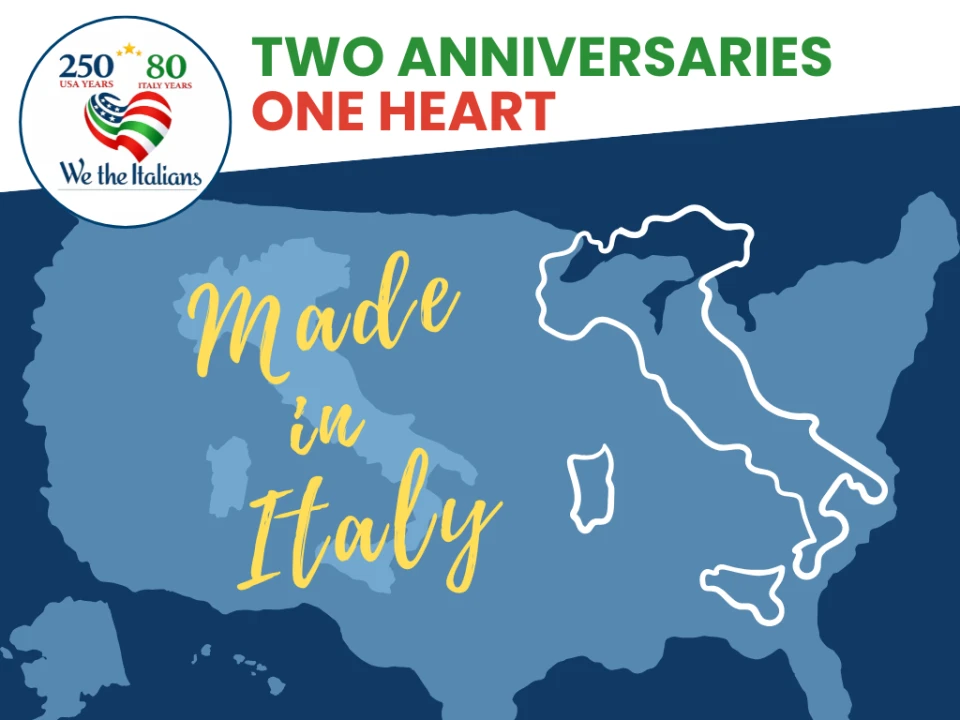

In 2026, We the Italians celebrates “Two Anniversaries, One Heart” – the 250th anniversary of the United States and the 80th anniversary of the Italian Republic. This article is part of the “Happy Birthday Italy” project, in which we explain why Italy is grateful to the United States for these past 80 years across 18 different sectors of our country’s life.
---
Made in Italy, powered by America
Made in Italy represents one of the fundamental strengths of our country’s economy on the global stage.
It is a distinctive hallmark of Italian production, giving everything that comes from the Italian peninsula a unique degree of originality and competitiveness.
People often ask what the essence of Made in Italy truly is. I believe the most convincing answer lies in the distinctive relationship between the Economy and Culture in Italy.
As the respected journalist Armando Massarenti wrote: “Why, despite everything, is our brand so extraordinarily successful? And what is this brand made of? It may seem surprising, but it can be summed up in a single word: Culture. We are the Country of Culture. Everywhere in the world.”
The 2012 Federculture Annual Report, “Culture and Development,” had already stated: “In the world, Italy means art and its cities. It is known for Bernini’s Colonnade, the Sassi of Matera, and Milan Cathedral. We have an extraordinary brand that remains powerful in the international imagination and highly effective commercially. Just as the Ferrero and Armani brands evoke Italian quality in the confectionery and fashion industries, the Amalfi Coast, Salento, and the Colosseum represent an extraordinary asset in terms of global visibility and reputation – one whose value we have yet to fully appreciate.”
Made in Italy can therefore be regarded as what might be called an “endocrine” element of our country – something that originates from within and permeates the entire national system.
This does not change the fact that Italy’s relationship with the United States over the past 80 years has been essential to its development. Without the American contribution, for a combination of reasons, Made in Italy would probably have remained smaller, less prosperous, less organized, and less influential around the world.
The first reason is historical. After World War II, Italy was a wounded country – physically devastated and psychologically exhausted. In that context, the United States was not merely a political and military ally, but also a driving force behind Italy’s economic reconstruction. The Western framework guaranteed by America provided stability, access to markets, international confidence, and an environment favorable to investment. Within this ecosystem, many Italian companies were able to recover, modernize their production processes, and prepare for the coming economic boom.
The second reason concerns the market. America has always been one of the most important markets for absorbing, appreciating, and paying a premium for Italian products. This is crucial. An industry does not truly grow simply because it produces quality – it grows when it finds consumers willing to recognize that quality economically. The United States has done exactly that for Italian fashion, furniture, food, wine, yachting, jewelry, specialized machinery, and luxury goods.
Then there is the cultural factor. The United States helped make Made in Italy desirable, not merely available. Movies, television, newspapers, advertising, major department stores, lifestyle magazines, and later digital media all served as enormous amplifiers of the Italian image. For millions of American consumers, Italy became synonymous with elegance, pleasure, quality of life, conviviality, everyday beauty, fine materials, and attention to detail. This symbolic capital had a direct impact on Italian businesses.
A fourth factor is the human bridge created by Italian Americans. Communities of Italian descent in the United States played a vital role in keeping familiarity with Italian culture alive and gradually transforming it into broader economic demand. First through family ties, and later through restaurants, importers, clubs, associations, local media, festivals, and commercial and professional networks, Italian Americans made Italy feel less distant and more accessible to the American market. They served as cultural interpreters, informal ambassadors, and often the first buyers or promoters of Italian products.
Nor should we underestimate the fact that the United States also compelled Made in Italy to improve. Entering the American market has never been easy. It means meeting high standards and dealing with professional distribution, advanced branding strategies, intellectual property protection, competitive packaging, effective communication, and demanding expectations regarding customer service. This competition benefited Italian companies. It forced them to move beyond a purely production-oriented approach and embrace a more comprehensive model based on brand identity, storytelling, consistency, reliability, and customer experience.
Italy’s relationship with capital, management, and modern commercial practices also benefited from its interaction with America. For many Italian companies, the United States became a practical school of organization, internationalization, and growth. Italy did not always imitate America successfully, but engagement with the United States almost always made the country more aware of its own strengths and weaknesses. One emblematic example is Adriano Olivetti and the educational journeys he made to the United States.
The relationship between Made in Italy and the United States has historically been extremely close and fruitful. It is highly desirable that it remain so in the future.
As noted at the beginning, Made in Italy finds its deepest essence in our country’s Culture – in other words, in our history and our roots.
At times, however, these roots can become an obstacle on our journey toward Tomorrow – a burden that slows the country’s progress toward the Future.
With its natural, historic, and deeply ingrained drive toward the New, the United States represents an irreplaceable source of inspiration for Made in Italy and a powerful force propelling it forward.