
Europe is facing a silent but costly crisis tied to an epidemic of sick days. While the major economic powers of the continent struggle with record absenteeism rates, Italy stands out positively, demonstrating resilience and dedication to work that defy international stereotypes.
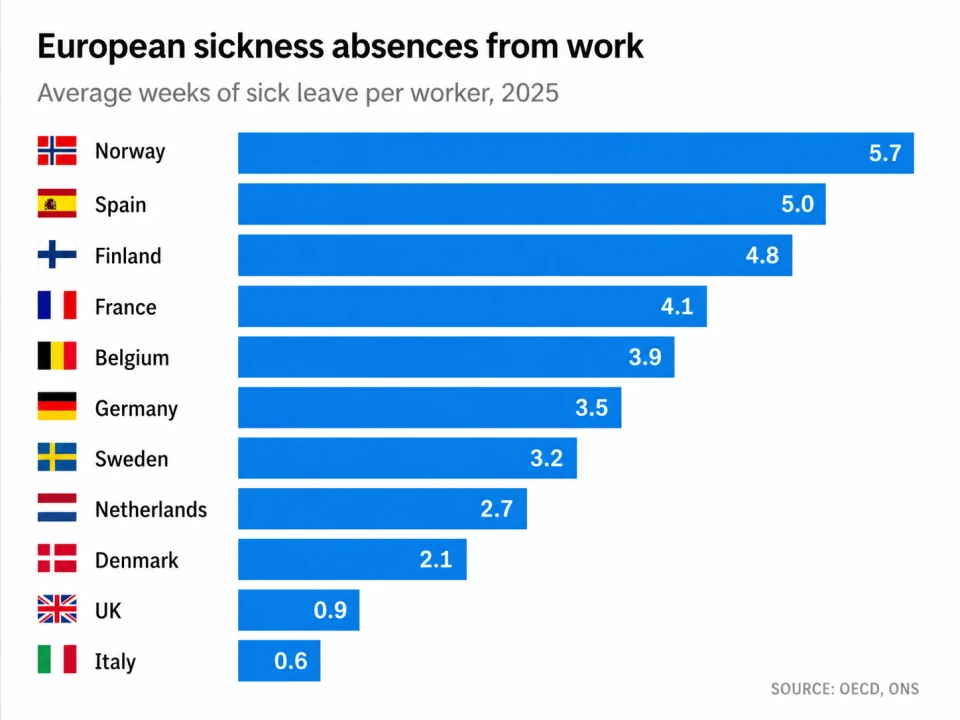
Across much of Northern Europe, governments are scrambling to save their economies. Germany, traditionally the economic engine of the continent, is undergoing a productivity collapse. German workers log a staggering average ranging from 14.8 to nearly 25 days of absence per year.
This record has pushed the Berlin government to declare war on easily obtained medical notes. The cost of these absences for German companies hit an incredible 82 billion euros in a single year. The German system, which guarantees 100% of a salary for the first six weeks, has proven unsustainable. To stop this, authorities are considering making medical certificates mandatory from the very first day of illness, eliminating the current three-day grace period.
Germany is not alone. Looking at the top of the European rankings, Scandinavian countries dominate the absenteeism charts. Norway leads the pack with almost 30 days a year – roughly six weeks of average absence per worker. This figure is prompting financial institutions to call for a drastic reduction in state subsidies, which now weigh in at nearly 8% of the gross domestic product. France is also tightening controls on medical certificates. Conversely, across the Channel, absent days drop to about 5.7 a year, but this occurs due to a punitive British system where state financial coverage is notoriously low.
In this fragmented landscape, Italy shines for its virtuous balance. Far from the alarming numbers of northern nations, the Italian workforce records a significantly lower average of about 9.5 – 10 days per year. This data highlights a strong sense of responsibility and a remarkable work ethic that are rarely celebrated enough. In Italy, employees show distinct dedication, keeping productivity alive in a complex global economy.
The Italian system is a winning model because it perfectly balances citizen health with business needs. While the framework guarantees financial protection from the start – with the first three days usually fully covered by the employer and subsequent days taken on by the state at rates between 50% and 66% – it also enforces strict rules. The requirement to submit medical certification within 48 hours and an effective network of state medical checks deter abuse without penalizing those who genuinely need care.
Furthermore, the Italian business fabric, largely made up of small and medium enterprises, fosters a direct relationship between employees and employers. Leave is not used as a shortcut to rest. Statistics confirm that over 70% of absences in Italy resolve spontaneously within the first five days, proving that illnesses are real, temporary, and faced with the intent to return to work quickly. This is a sharp contrast to the prolonged absences crippling neighboring nations.
Companies on the peninsula do not suffer the massive financial blows paralyzing Northern industries. Italian workers remain attached to their jobs, ensuring an operational continuity that Berlin and Oslo envy today. While the North must dismantle overly permissive welfare systems, Italy already has a solid framework. When it comes to professionalism and workplace attendance, Italy stands as a benchmark for a Europe desperately trying to cure its absences.