
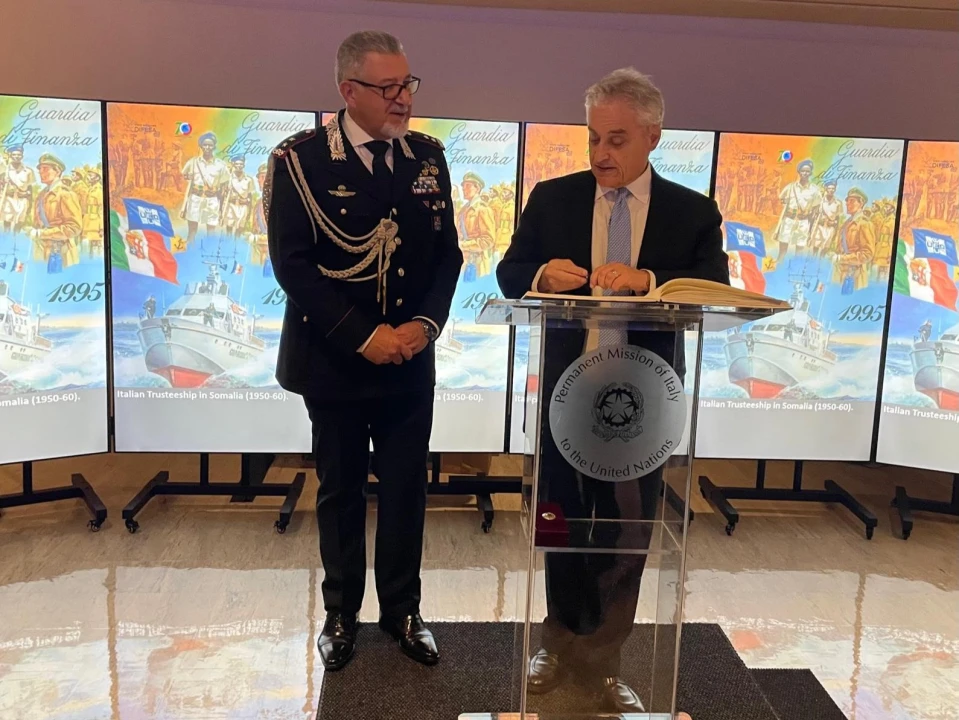
Inside the UN Headquarters in New York, one of the events marking the 70th anniversary of Italy’s admission to the United Nations General Assembly was held.
During the event, an exhibition was inaugurated and the historical–photographic volume “70 Years Since Italy’s Admission to the United Nations – Italian Blue Helmets in the Service of Peace”, curated by Alfonso Manzo and Maria Gabriella Pasqualini, was presented.
The event was promoted by the Italian Ministry of Defense and organized by the Italian Defense General Staff, as part of a broader program of initiatives aimed at raising awareness of the central role played by the Italian Armed Forces in peacekeeping operations under the auspices of the United Nations.
Among Western countries, Italy leads in the number of military personnel deployed in peacekeeping missions, standing out in particular in the complex UNIFIL operation in Lebanon, currently under the command of Major General Diodato Abagnara of the Italian Army.
On December 14, 1954, at the end of an evening meeting of the Security Council, Italy’s admission to the UN General Assembly was approved. That same day, Albania, Jordan, Ireland, Portugal, Hungary, Austria, Romania, Bulgaria, Finland, Ceylon, Nepal, Libya, Cambodia, Laos, and Spain were also admitted.
Those attending the ceremony included Italy’s Permanent Representative to the United Nations in New York, Ambassador Maurizio Massari, and Mr. Atul Khare, UN Under-Secretary-General for Operational Support to Peacekeeping Missions. Also present were Permanent Representatives to the United Nations, Defense Attachés and Military Advisors (MILADs) from numerous member states, representatives of the European Union, INTERPOL, and the NYPD, as well as members of the Italian community, Italian veterans’ and military associations in New York, journalists from various local outlets, and several military, civilian, and religious authorities.
Speakers during the celebration included Ambassador Maurizio Massari, USG Atul Khare, and Carabinieri Major General Alfonso Manzo, Defense Attaché and Military Advisor at Italy’s Permanent Mission to the UN. In their remarks, all highlighted the crucial contribution made by the Italian Armed Forces to peacekeeping efforts under the UN flag – a commitment that began even before Italy’s official admission to the United Nations in 1955.
Italy’s participation in UN multilateralism and international security dates back to the late 1940s, when Italian personnel were deployed in some of the most delicate crisis areas of the time: from the mission between India and Pakistan, to the Italian Trusteeship Administration in Somalia, to the Congo, where in 1961 thirteen Italian airmen were brutally killed in Kindu – one of the most tragic episodes in peacekeeping history.
All speakers paid tribute to the roughly 50 Italian service members who have fallen in the line of duty during more than seventy years of UN peacekeeping operations.
In summarizing the contents of the volume and the exhibition, the speakers emphasized how the very concept of UN peacekeeping began to take shape in the early 1950s, when Dag Hammarskjöld, UN Secretary-General from 1953 to 1961, introduced a new approach to addressing international crises. This model moved beyond simply deploying military observers or interposition forces, and evolved into a more structured activity built on three fundamental principles: neutrality, consent of the parties in conflict, and the use of force limited strictly to the self-defense of UN personnel.
The peacekeeping missions deployed between the mid-1960s and late 1980s helped define the procedures for managing regional conflicts. The challenges of that era were only a prelude to those that would emerge with even greater scale and complexity beginning in the 1990s.
With the end of the Cold War – which had deeply shaped international politics and conflict dynamics – UN peacekeeping operations returned to center stage.
In the first quarter of the 21st century, beginning with the publication of the Brahimi Report, considered the cornerstone of modern peacekeeping and peacebuilding, UN missions reached a historic peak in 2010, with more than 100,000 uniformed peacekeepers deployed simultaneously. During this same period, the budget allocated to peace operations more than doubled the total amount spent between 1948 and 2000.
Among the Italian figures who distinguished themselves in service to peace under the UN banner are:
– Brig. Gen. Franco Angioni, Commander of the Italian Contingent in Lebanon (1982–1983);
– Maj. Gen. Alfonso Pessolano, Commander of UNMOGIP (United Nations Military Observer Group in India and Pakistan) from 1991 to 1994;
– Second Lieutenant Maria Cristina Luinetti, Italian Red Cross volunteer nurse, recipient of the Order of Merit of the Italian Republic, and the first Italian woman killed in a peacekeeping mission (Mogadishu, December 9, 1993);
– Giandomenico Picco, UN Secretariat official from 1973 to 1991 and close collaborator of Secretary-General Javier Pérez de Cuéllar, involved in some of the most complex international negotiations of the era (Cyprus, the 1985 France–New Zealand crisis, Afghanistan, Lebanon);
– The five Italian UNIFIL Commanders from 2006 to the present, including Gen. Claudio Graziano and Gen. Luciano Portolano, both of whom later became Chiefs of the Italian Defense General Staff.